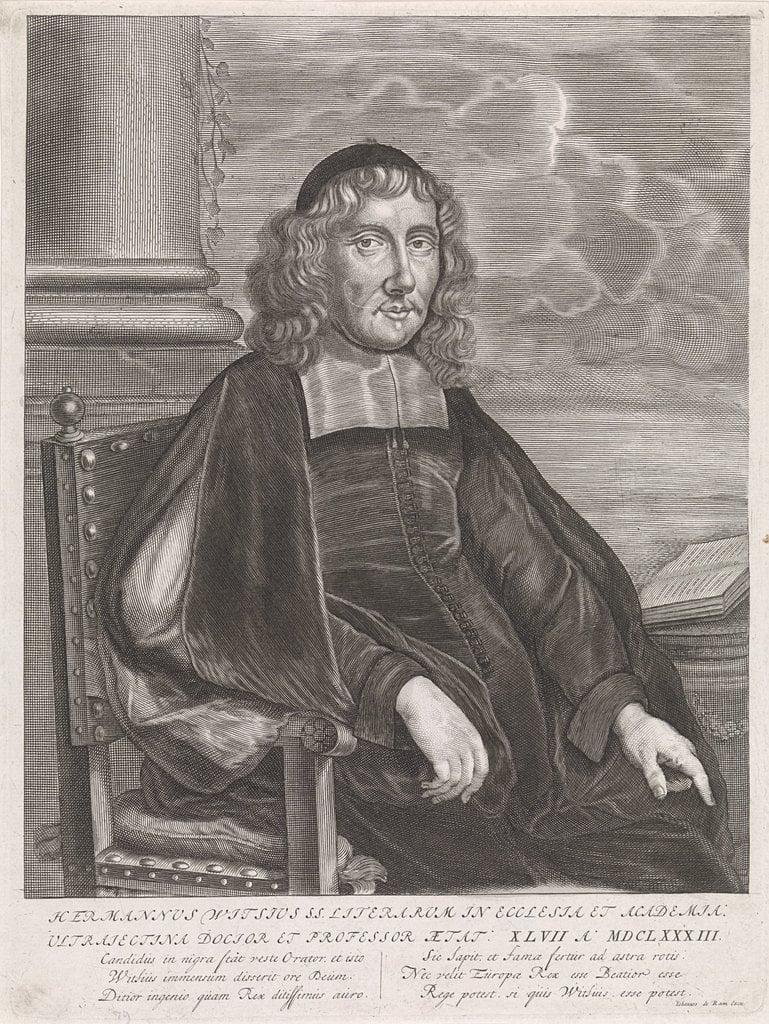
Herman Witsius played a significant role in the development of Reformed Covenant Theology. His book, The Economy of the Covenants Between God and Man, has been described as, “one of the most important works available in English” [1]
But what did he believe about Israel? What would he think of a Dispensational Federalism? I’ll let you read his words and you can draw your own conclusions:
“We may reckon among the benefits of the New Testament the restoration of the Israelites, who were formerly rejected, and the bringing them back to the communion of God in Christ. Paul has unfolded this mystery to the Gentiles, Rom. 11:25–27:
“For, I would not, brethren, that ye should be ignorant of this mystery (lest ye should be wise in your own conceits), that blindness in part is happened to Israel, until the fulness of the Gentiles be come in. And so all Israel shall be saved; at it is written, There shall come out of Sion the deliverer, and shall turn away ungodliness from Jacob. For this is my covenant unto them, when I shall take away their sins.”
XXI. On this place observe, 1st. That the apostle here explains some mystery; that is, a secret thing, not known but by revelation, and taken notice of by few, and happening beyond the expectation and judgment of reason; in fine, the whole method and manner of executing which, lies in a great measure concealed; see 1 Cor. 2:7, 15:51, and Eph. 3:3.
2dly. That it is the interest of the Gentiles to be acquainted with this mystery, to prevent their entertaining higher thoughts concerning themselves, and lower concerning the Israelites: we are therefore to take care to enquire diligently, and with attention, into what the prophets have foretold concerning this matter.
3dly. The apostle here speaks of the people of Israel, not figuratively but properly so called; who were at this time blind, obdurate, stupid, and hardened, of which ver. 7. Isaiah foretold this judgment of God against Israel at large, chap. 6:9, 10, compared with Acts 28:26, Isa. 29:10, 11… In short, this is that forlorn condition of the blinded nation of Jews, which taking its rise in the apostles’ time, continues to this our day.
4thly. That this blindness is in part happened to Israel…
5thly. That blindness is to continue upon them no longer, than till the fulness of the Gentiles be come in… The offer of grace was first made to the Israelites. When they refused it, it was sent to the Gentiles; but when the fulness of them shall be brought in, it will be again given to the Israelites, “that the last may be first, and the first last,” Luke 13:30; see Luke 21:24.
6thly. That when the fulness of the Gentiles is brought in, all Israel shall be saved; that is, as our Dutch commentators well observe, not a few, but a very great number, and in a manner the whole Jewish nation, in a full body…
XXII. From what we have said before, it appears, that they depart from the apostle’s meaning, who, by all Israel, understand the mystical Israel, or the people of God, consisting both of Jews and Gentiles, without admitting the conversion of the whole Jewish nation to Christ, in the sense we have mentioned. Notwithstanding this may be confirmed by the following arguments. 1st. The apostle speaks of that Israel, to whom he ascribes his own pedigree, ver. 1; whom he calls his flesh, that is, his kindred, ver. 14, and the natural branches, ver. 21; whom he constantly distinguishes from the Gentiles; to whom, he testifies, blindness is happened. All this is applicable to Israel properly so called. 2dly. He lays before us a mystery; but it was no mystery, that a very few Jews were converted to Christ together with the Gentiles; for we have daily instances of that. 3dly. He reminds the Gentiles, not to exult over, or despise the Jews, from this argument, that, as they themselves were now taken in among the people of God, so, in like manner, the Jews were in due time to be taken in again. But if the apostle meant, that the body of the Jewish nation was to continue in their hardness; and but a few of them to be saved, who, joined to the Gentiles, should form a mystical Israel, the whole of that discourse would be more adapted to the commendation of the Gentiles, than of the Israelites; and encourage, rather than repress, the pride of the Gentiles. 4thly. As the fall and diminishing of Israel, ver. 12, and their casting away, ver. 15, are to be understood; so likewise the receiving and saving them; for here the rules of a just opposition must be observed. But the fall, diminishing, and casting away of Israel, are to be understood of the generality of the Jewish nation; therefore, the receiving and saving of Israel in like manner.
XXIII. From which it is evident, that Grotius trifles, when he is positive, that this prophecy was fulfilled, at that time, when the idols and military ensigns of the Romans were openly seen in the temple; because, that then many who had embraced Christianity, together with those who had been Christians before, were exempted from the following calamities. To which was added the conversion of many Jews, upon the destruction of the city and temple, since now the truth of Christ’s predictions appeared in a much clearer light, and the galling yoke of personal bondage had broke the obstinacy of many, as Vespasian and Titus put no bar in the way; for proving this he quotes a passage from Justin, adversus Tryphonem. But such absurd imaginations are contrary to the light of all history. For, during the siege, the whole of the Jewish nation, which was all over plunged in their guilt and perfidy, were made to suffer the just punishment of their sins. Which is very far from that salvation, which Paul here assures us of. If any joined the Christians at that time, their number was so inconsiderable, compared with the rest, as, that it is ludicrous to give them the name of all Israel. Justin says nothing, but that some of them, being daily instructed in the name of Christ, had quitted the way of error; which differs very much from all Israel. We may add, that by that fancy of Grotius, the times of casting away and receiving are entirely confounded. For never was the breaking off and cutting away the natural branches more palpably seen, according to the Baptist’s prophecy, Matt. 3:10, than at that time that Grotius imagines they were grafted in.
XXIV. In fine, the prophetic testimony, alleged by the apostle from Isa. 59:20, confirms our explanation; where the Hebrew words properly denote, the Redeemer shall comeלציון, to Zion; or, according to the Septuagint, ἓνεκεν Σιὼν, on account of Zion, and unto them that turn from defection in Jacob. Paul, generally following the Septuagint, has rendered the words somewhat differently, but to the same purpose and meaning.
XXV. Observe, 1st. That the apostle here very justly explains Zion and Jacob of the Jews; for these are the natural sons of Jacob, natives, citizens of Zion; the others are only naturalized, that name therefore primarily, and of itself, agrees to them. And then also he speaks of those with whom the covenant was made; as it is said in the text, ver. 21, “This is my covenant with them:” but that testament and covenant belong to Israel, “whose are the covenants and promises,” Rom. 9:4; see Lev. 26:44, 45. Moreover, Zion and Jacob denote, not some few of Israel, but the whole body of that notion, as Gen. 49:7. For in Zion all the tribes had a right, Ps. 122:4. XXVI. 2dly. Theנואל Goel is promised to Zion, that is, the Kinsman-Redeemer, who can justly say these are mine, and that in right of consanguinity, for I am the nearest kinsman. True it is, Christ may be called the Goel and near kinsman of all nations, on account of his being of the same human nature with them, which he assumed; yet he is chiefly and first of all the Goel of Israel, because of them are the fathers, of whom as concerning the flesh Christ came, Rom. 9:5…
XXVII. 3dly. The work of this redeemer will be to turn away iniquity from Jacob. In the Hebrew it runs, “he shall come to those that return from defection.” The meaning is the same; he will impart his grace and salvation to those who, by a true faith and repentance, shall return unto God… The sum of the whole is, that, by the efficacy of the Redeemer, the Jews are in due time to be converted from their rebellion and transgressions.
XXVIII. 4thly. As this is not yet accomplished as to the whole body of the Israelites, and yet the Scripture must be fulfilled, the apostle has justly inferred, that in the last times it will be perfectly fulfilled. For, seeing the foundation thereof is God’s covenant with Israel, and this a firm covenant, stable, immutable, and suspended on no ambiguous condition (for what condition could that covenant admit, which allots both remission of sins and repentance to Israel?) it is not possible, but that every thing shall happen exactly according to the promise and prediction. And this is my covenant with them, saith God. But concerning this covenant he speaks as follows, Isa. 54:10: “For the mountains shall depart, and the hills be removed, but my kindness shall not depart from thee, neither shall the covenant of my peace be removed, saith Jehovah, that hath mercy on thee.” And again, Jer. 33:25, 26: “Thus saith Jehovah, if my covenant be not with day and night, and if I have not appointed the ordinances of heaven and earth, then I will cast away the seed of Jacob, and David my servant.” Add Ps. 105:8, 9, and Deut. 4:31. All this being addressed to the whole body of the nation, it must of necessity be fulfilled at the appointed time.
XXIX. 5thly. But because some perhaps might think, that those horrid crimes, of which the Israelites had been guilty, might hinder that blessing of God from coming to them; the apostle adds a testimony whereby God promises to take away their sins, which cannot but be accompanied with repentance and faith in the Messiah, and the communication of his grace. True, indeed, it is, we have not those words in Isa. 54. But yet they are in Isa. 27:9, where the Greek Version has the very words, ὃταν ἀφελωμαι τὰς ἁμαρτίας αὐτῶν. It is not unusual with the apostle to collect several testimonies into one, and to explain the words of one passage by those of another. And indeed this observation was of great importance; for, if any thing should seem to stand in the way of the restoration of the Jews, it was their extreme impiety. Wherefore there are frequent promises concerning the expiation of the crimes they had committed, as Deut. 32:43, Jer. 33:8, and Jer. 50:20…
XXXI. Should any one desire clearer testimonies, we offer the following to his consideration: from Moses, Lev. 26:41–45; Deut. 4:30, 31; Deut. 30:1–6; and Deut. 32:43. From the Psalms, Ps. 102:14–18, and Ps. 85:9, 10. From Isaiah, Isa. 11:11, 12; Isa. 19:24, 25; Isa. 49:14, &c.; Isa. 62 throughout. From Jeremiah, Jer. 3:18, &c.; Jer. 31:1, and from ver. 31 to the end; Jer. 32:37, &c.; Jer. 33:24–26. From Ezekiel, Ezek. 36:24, to the end; Ezek. 37 throughout, especially from ver. 15; Ezek. 39:25, to the end. Add Hosea 3:5. All these promises are more sublime, than that the time can be assigned, in which they can be supposed to have been as yet fulfilled. From the New Testament, add Matt. 23:29; Luke 21:24; 2 Cor. 3:16. The reader may please to see what we have said on this head in a particular book concerning the ten tribes of Israel, from chap. 9. to the end; where he will find most of those prophecies carefully, and at greater length explained.
XXXII. From all this it is evident, we are to expect the general conversion of the Israelites in time to come, not indeed of every individual, but of the whole body of the nation, and of the twelve tribes. We choose not to multiply minute questions, either out of curiosity or incredulity, concerning the time, place, manner, means, and the like circumstances of this mystery, which God has reserved in his own power. Let us maintain the thing itself, and leave the manner of it to God. We shall then best of all understand those obscure prophecies which describe it, when we shall be able to compare the event with them.” [2]
[1] R. Scott Clark, Heidleblog Article, https://heidelblog.net/2010/05/witsius-is-back/
[2] Herman Witsius, The Economy of the Covenants Between God and Man, IV, XV, XX-XXXII.

 Dispensational Federalism